
Most of us are familiar with ocean tides, rising and falling on a 24-hour cycle due to the gravitational pull of the moon and, to a lesser extent, the sun. However, fewer people know that the earth itself experiences a similar phenomenon—earth tides—where the ground rises and falls in a rhythmic, almost breathing-like motion. Think of it as the Earth “breathing” in and out. In the UK, modern GPS technology has measured these earth tides to shift the ground by approximately 12 inches over a 24-hour cycle.
Although we rarely feel it—unless we experience an earthquake or tremor—the earth is constantly in motion, much like the ocean’s waves. This continuous movement causes friction along subsurface faults, fractures, cracks, and crevices. Our Micro-Seismic Resonance (MSR) instrument detects these subtle resonance signals generated by varying levels of competence in the subsurface. It excels at distinguishing between areas of solid, competent rock (low resonance) and voids or fractures (high resonance).
To understand this concept, imagine the sound produced when you rub your finger around the rim of a crystal glass. The pitch or tone varies depending on the amount of water inside. The same principle applies to the earth. Our MSR equipment is finely tuned to “listen” to the different resonance signals beneath the surface, identifying areas of weakness, voids, or fractures—critical targets for well-siting.
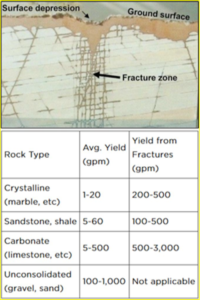
Wells drilled into fractured formations often yield significantly more water than those in non-fractured rock. This advantage is supported by research, including a study from PennState Extension titled “Water Well Location by Fracture Trace Mapping” (Swistock & Sharpe, 2015). Fracture trace mapping refers to the identification of topographical and detectable lineaments that reveal subsurface fracture patterns. The table below (from the referenced article) demonstrates the considerable increase in well yields across Pennsylvania when fracture detection techniques were used prior to drilling.
Table A. Comparison of water yields from typical wells versus fracture-trace wells in various rock types (from Swistock & Sharpe, 2015).
A substantial body of evidence strongly supports the use of fracture networks as prime well targets. Particularly in mountainous regions, aquifers behave more like intricate “plumbing systems” fed by deeply rooted fractures, rather than traditional holding basins. Precision in drilling is crucial in these conditions.
At WaterTech Worldwide, we use an innovative passive seismic technique to target zones of higher porosity and permeability, such as fractured bedrock or unconsolidated gravel zones. In tandem with this, we apply a radiometric gamma technique, finely tuned to detect lineaments and areas where water vapour may “vent,” further signalling potential fracture zones. This powerful combination has been highly successful in selecting optimal drill targets across numerous case studies, providing accurate, high-yield well-siting results.